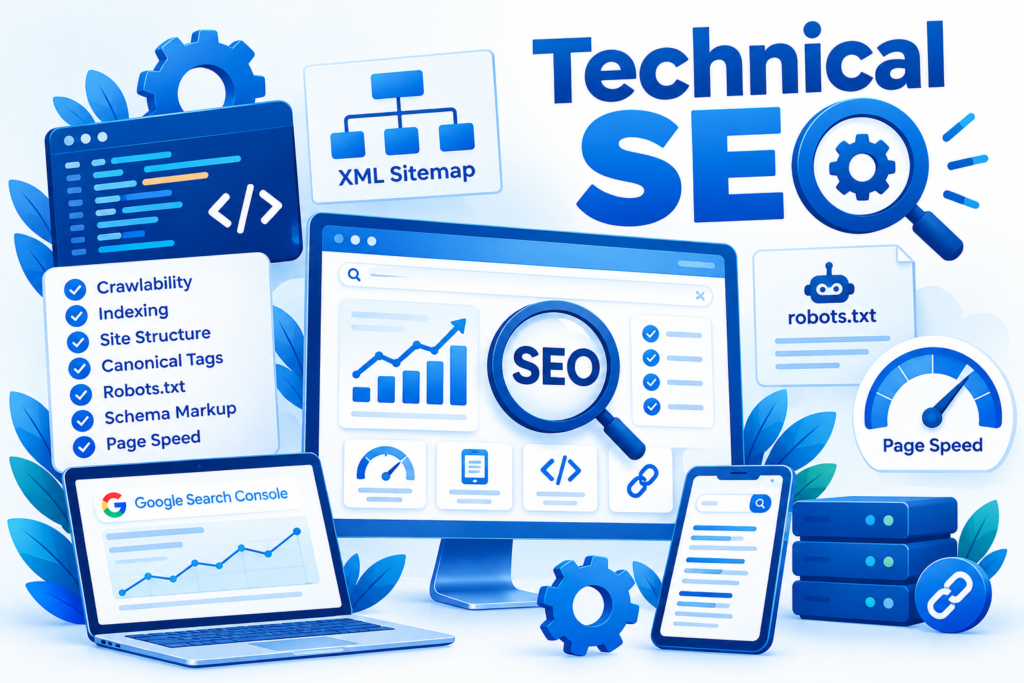
SEO
Improve Your Google Visibility with Professional SEO
Want your website to appear higher on Google and reach more potential customers? My SEO services are designed to improve your website’s search visibility, attract relevant organic traffic, and build a strong online presence.
I use a strategic and data-driven approach to help businesses improve their search engine performance. From keyword research and on-page SEO to technical optimization and content SEO, every part of your website is optimized with your business goals in mind.
SEO SERVICES
SEO services are professional offerings, usually from an agency or freelancer, that help your website rank higher in search results and attract more organic traffic. Instead of doing the work yourself, you hire specialists to handle it.
What SEO services usually include:
- SEO audit: A review of your site to find problems and opportunities, such as slow pages, broken links, or missing titles.
- Keyword research: Finding the words and phrases your customers actually search for.
- On-page optimization: Improving titles, headings, meta descriptions, images, and internal links.
- Content creation: Writing original articles, product descriptions, and landing pages.
- Technical SEO: Fixing site speed, mobile usability, security (HTTPS), crawling and indexing issues.
- Link building: Earning backlinks from trustworthy websites.
- Local SEO: Optimizing your Google Business Profile and local listings for “near me” searches.
- Reporting: Regular updates on rankings, traffic, and leads.
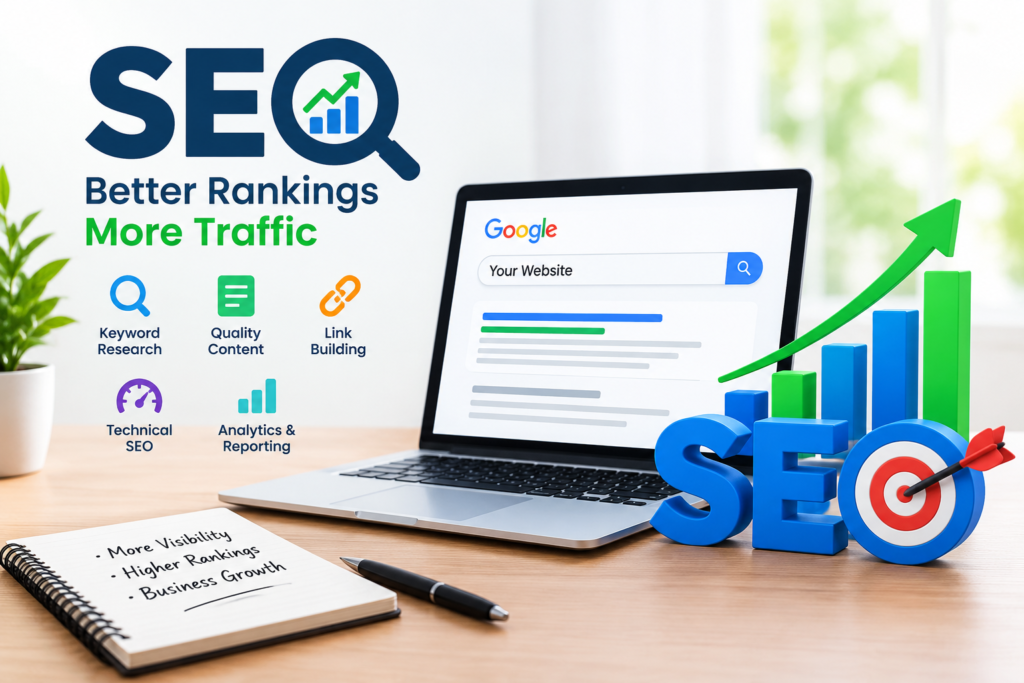
TECHNICAL SEO
Technical SEO is the part of SEO that focuses on your website’s infrastructure, making sure search engines can easily find, crawl, understand, and index your pages. It’s about how the site is built, not what the content says.
Main areas of technical SEO:
- Crawlability: Search engines must be able to reach your pages. This involves a clean
robots.txtfile, an XML sitemap, and avoiding broken links or pages that are buried too deep. - Indexability: Pages you want in search results shouldn’t be blocked by
noindextags or wrongly canonicalized. Use canonical tags to tell search engines which version of a page is the main one. - Site speed: Faster pages rank better and keep visitors. This means compressing images, using caching, minimizing code, and choosing good hosting.
- Core Web Vitals: Google’s page experience metrics: loading speed (LCP), responsiveness (INP), and visual stability (CLS).
- Mobile-friendliness: Google mostly uses the mobile version of your site for ranking, so it must work well on phones.
- HTTPS: A valid SSL certificate so the site is secure.
- Site structure and URLs: Logical hierarchy, short readable URLs, and good internal linking.
- Structured data (schema markup): Extra code that helps search engines understand your content and can earn rich results like star ratings or FAQs.
- Duplicate content and redirects: Fixing duplicate pages and using proper 301 redirects instead of long redirect chains or 404 errors.
- JavaScript rendering: Making sure content loaded by JavaScript can still be seen by search engines.
Common tools:
- Google Search Console (free, essential)
- PageSpeed Insights
- Screaming Frog
- Ahrefs or Semrush site audit